
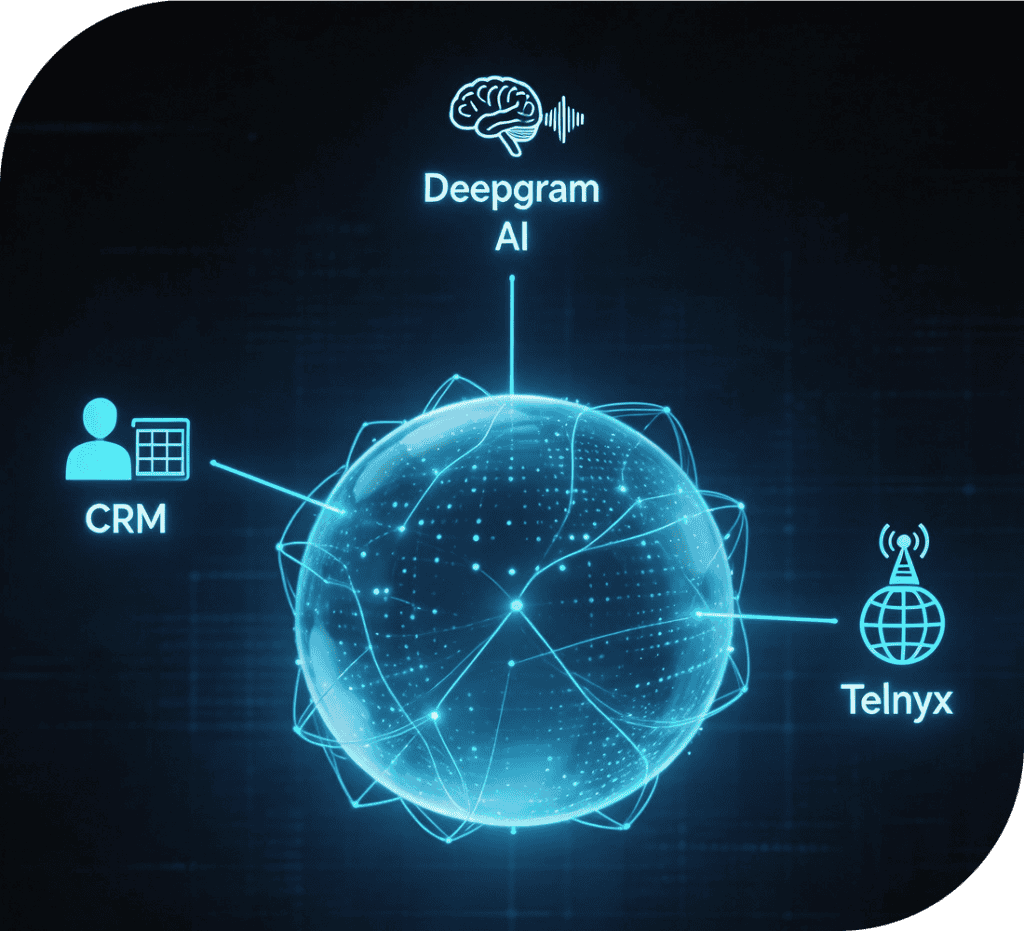
Every System You Already Use Already Talking to Your Phone System
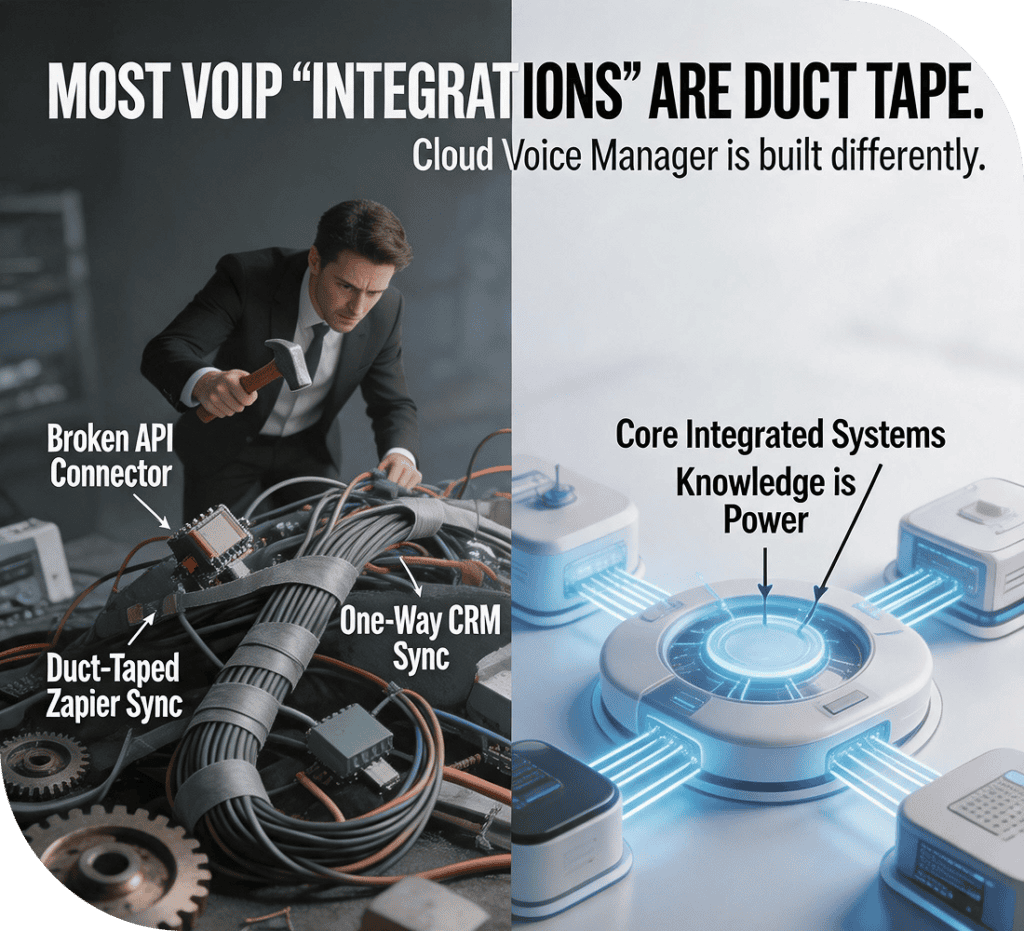
Most VoIP 'Integrations' Are Duct Tape
What That Actually Means:
Native, Not Plugged-In
The HMS Cloud Fleet integrations are part of the data model. There is no connector to configure, no middleware to monitor, no subscription to renew. They ship with the product.
Bidirectional by Default
Calls, messages, and AI interactions write to the CRM automatically, and CRM contact data informs every inbound call before the agent picks up. Data flows both ways — always.
Open Where It Counts
Outside the native stack, a documented REST API and configurable webhooks let your team connect anything else — helpdesk, BI, ticketing, automation tooling, internal tools — without a vendor in the middle.
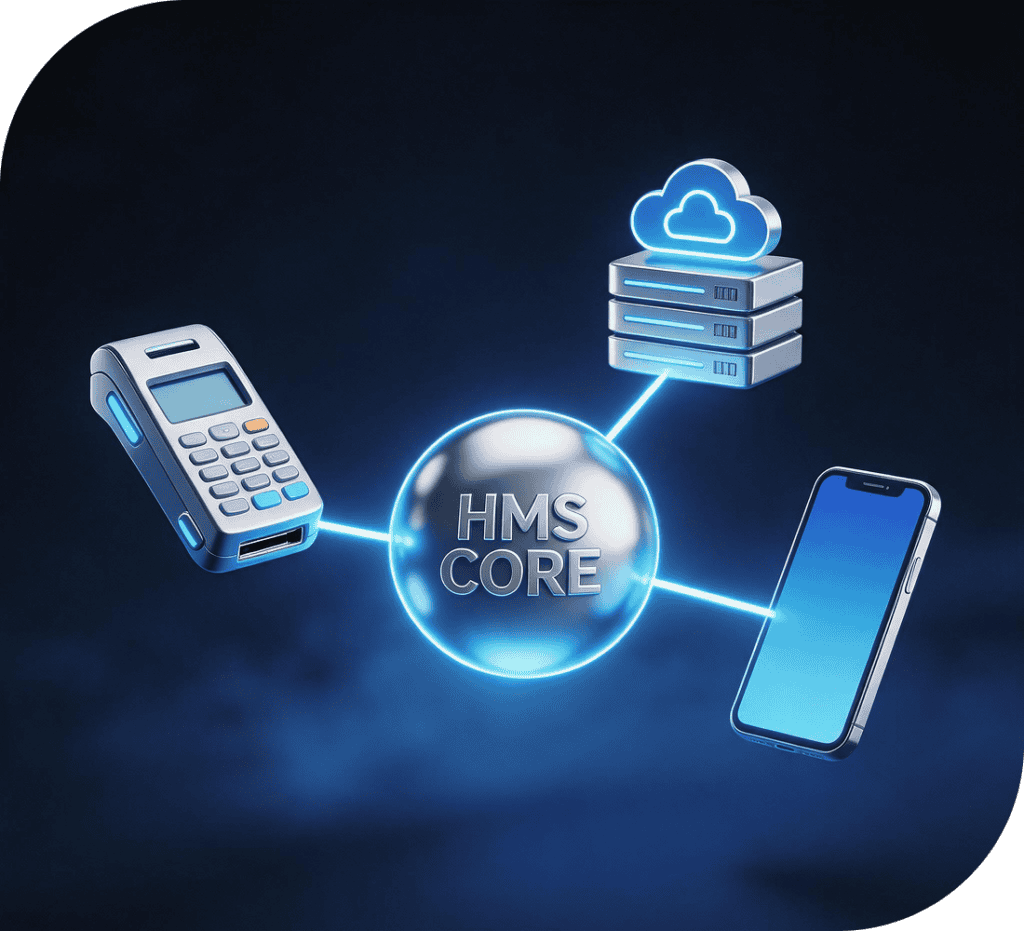
The HMS Cloud Fleet, Connected at the Core
Host Merchant Services
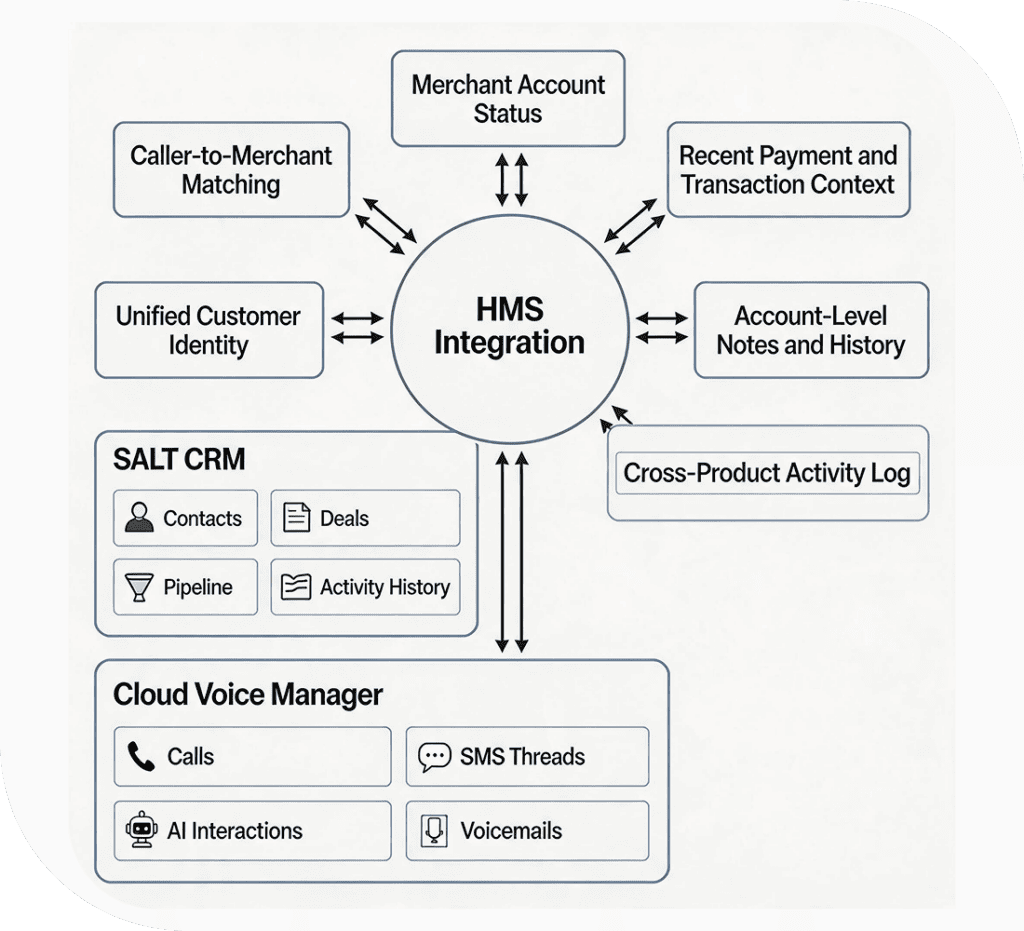
What Flows Through the HMS Integration:
- Caller-to-merchant matching on inbound call — the right account is on screen before your agent says hello
- Merchant account status visible in the active-call view
- Recent payment and transaction context available to AI agents during live calls
- Account-level notes and history attached to every call record
- Cross-product activity log — a merchant's interaction history across HMS products in one view
- Unified customer identity — the same merchant record across HMS, SALT CRM, and Cloud Voice Manager
SALT CRM
What SALT CRM Integration Does Automatically:
Caller ID Matching
Every inbound call is matched against the SALT CRM contact database in real time. Your agent's screen shows name, company, account history, and last interaction before the call connects.
Call Activity Logging
Every inbound and outbound call creates a structured activity record in SALT CRM — call duration, disposition, direction, agent, and a link to the recording and transcript.
AI Interaction Logging
Every AI voice agent conversation is logged to SALT CRM the same way a human call would be — with the full transcript, AI-generated summary, and outcome classification attached.
Post-Call Summaries
AI-generated summaries are pushed to the contact's SALT CRM record automatically. Your pipeline stays current without a single manual log entry.
SMS Threading
Every SMS sent or received on a business number attaches to the matching SALT CRM contact. A single thread across voice, SMS, and AI interactions lives on one timeline.
Voicemail Attachment
Voicemails and their Deepgram transcripts attach directly to the caller's contact record in SALT CRM — searchable, retrievable, and linkable.
Pipeline-Stage Triggers
Configurable rules can move a deal's stage in SALT CRM based on call outcome (demo booked, objection handled, deal closed).
Contact Creation from Unknown Calls
Inbound calls from unknown numbers can auto-create a contact record in SALT CRM with the call as the first activity — no manual entry required.
Task Creation from Calls
AI agents and human agents can create tasks in SALT CRM directly from the call — follow-up reminders, ticket routing, or escalation.
Cloud AI Manager
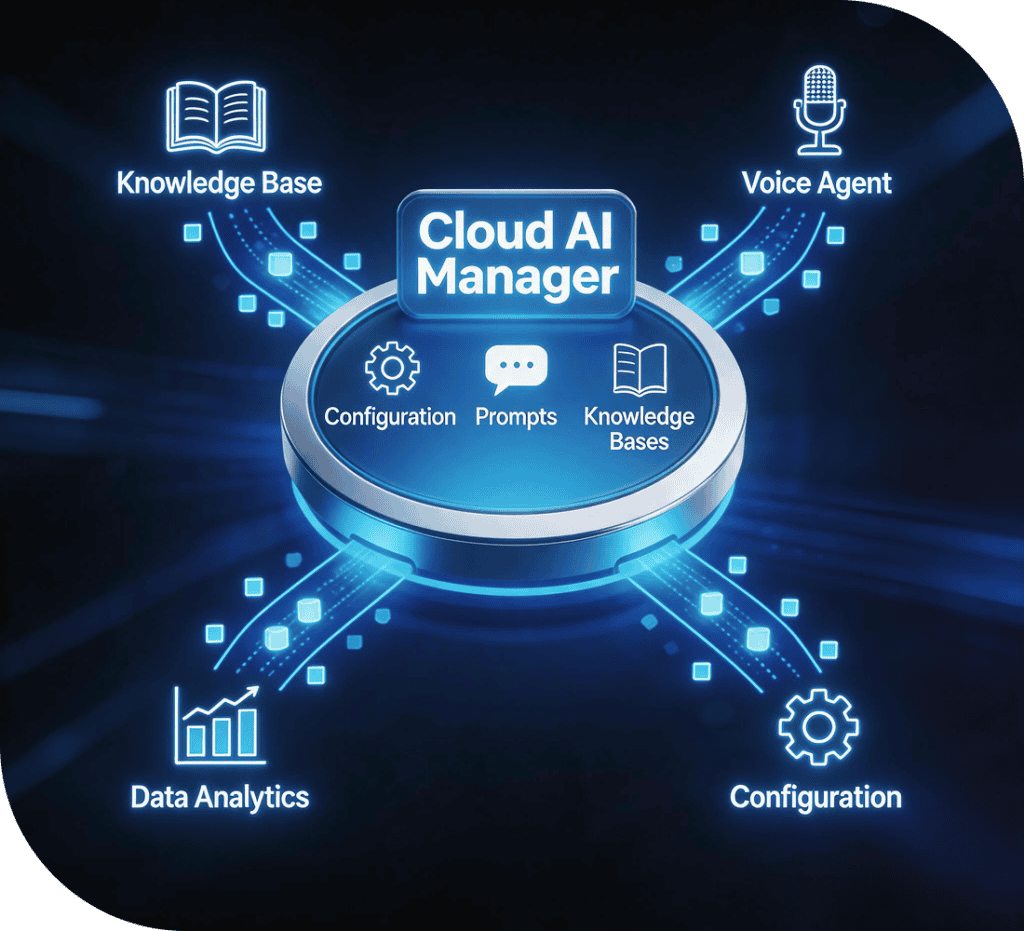
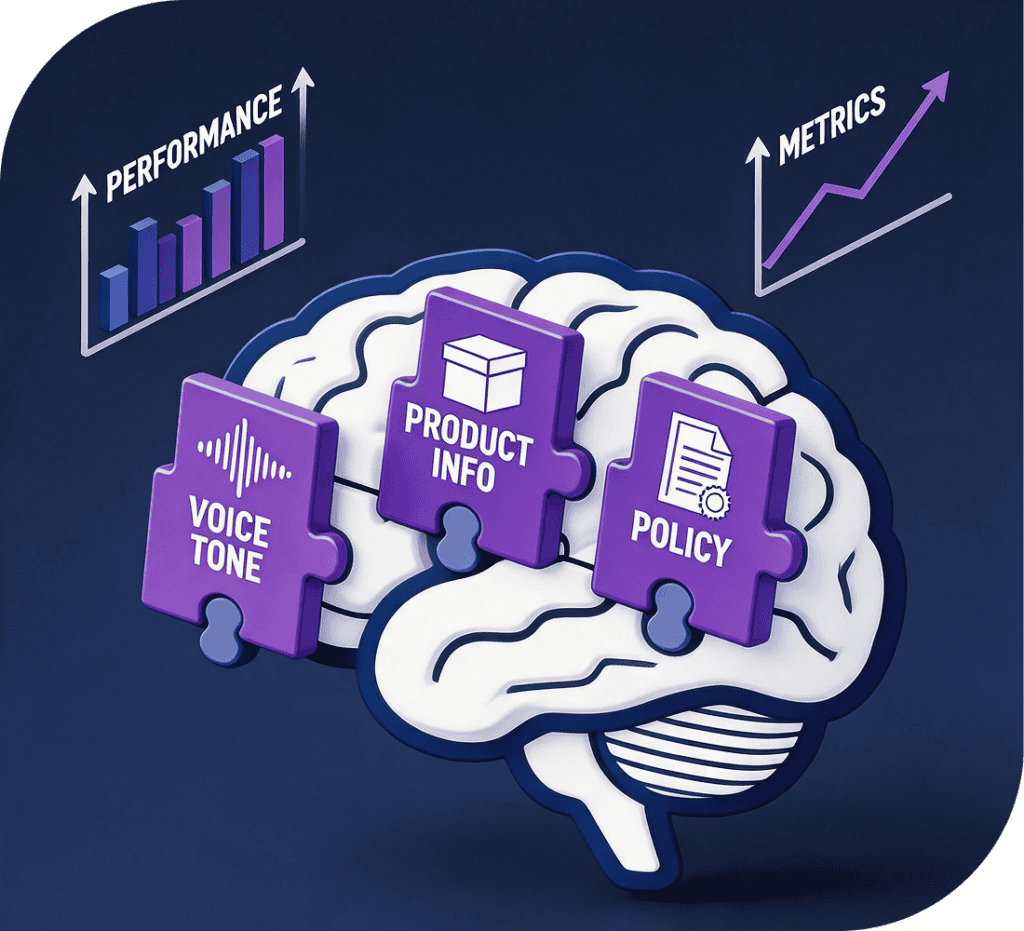
Cloud AI Manager is the central control plane for AI behavior across HMS products. For Cloud Voice Manager, this means AI agent personas, conversation prompts, and the knowledge bases they draw from are defined once in Cloud AI Manager and applied automatically to every relevant call flow. Update a policy in one place, and every AI voice agent reflects it immediately.
What the Cloud AI Manager Integration Provides:
- Centralized AI agent persona library — voice, tone, and personality defined once, applied everywhere
- Knowledge base seeding — product info, FAQs, hours, policies, and pricing synced into AI agent lookups
- Prompt template management — shared prompt building blocks across voice, chat, and other AI surfaces
- Knowledge base versioning — roll back or promote knowledge updates across the fleet
- Per-tenant and per-brand persona scoping — white-label AI configurations for multi-tenant deployments
- Analytics on AI agent performance — resolution rates, escalation rates, unhandled queries — surfaced back into Cloud AI Manager for iteration
- Consistent AI behavior across every HMS product the customer interacts with
Telnyx — The Carrier Layer, Built In
What the Telnyx Integration Powers
DID Number Provisioning
Search, buy, and assign phone numbers directly from the Cloud Voice Manager dashboard. Local, toll-free, and international numbers available on demand.
SIP Trunking
Carrier-grade SIP trunking with redundant carrier routes. Call delivery is enterprise-class without enterprise configuration.
Number Porting
Keep your existing business numbers. The porting workflow is managed inside Cloud Voice Manager — submit, track, and complete ports without leaving the admin panel.
A2P 10DLC Registration
Required for legitimate business SMS in the US. Brand and campaign registration is handled through the Telnyx integration, surfaced in the CVM dashboard.
International Coverage
Inbound and outbound calling in most major markets. International DIDs available where supported by Telnyx.
Carrier Redundancy
Automatic failover across Telnyx's global POP infrastructure. Call delivery stays reliable even when individual routes degrade.
Real-Time Media for AI
Low-latency RTP media streaming powers AI voice agent conversations with sub-second responsiveness.
Usage Reporting
Telnyx-side usage data (call minutes, SMS volume, DID counts) is surfaced inside Cloud Voice Manager's admin reporting — no separate dashboard to check.
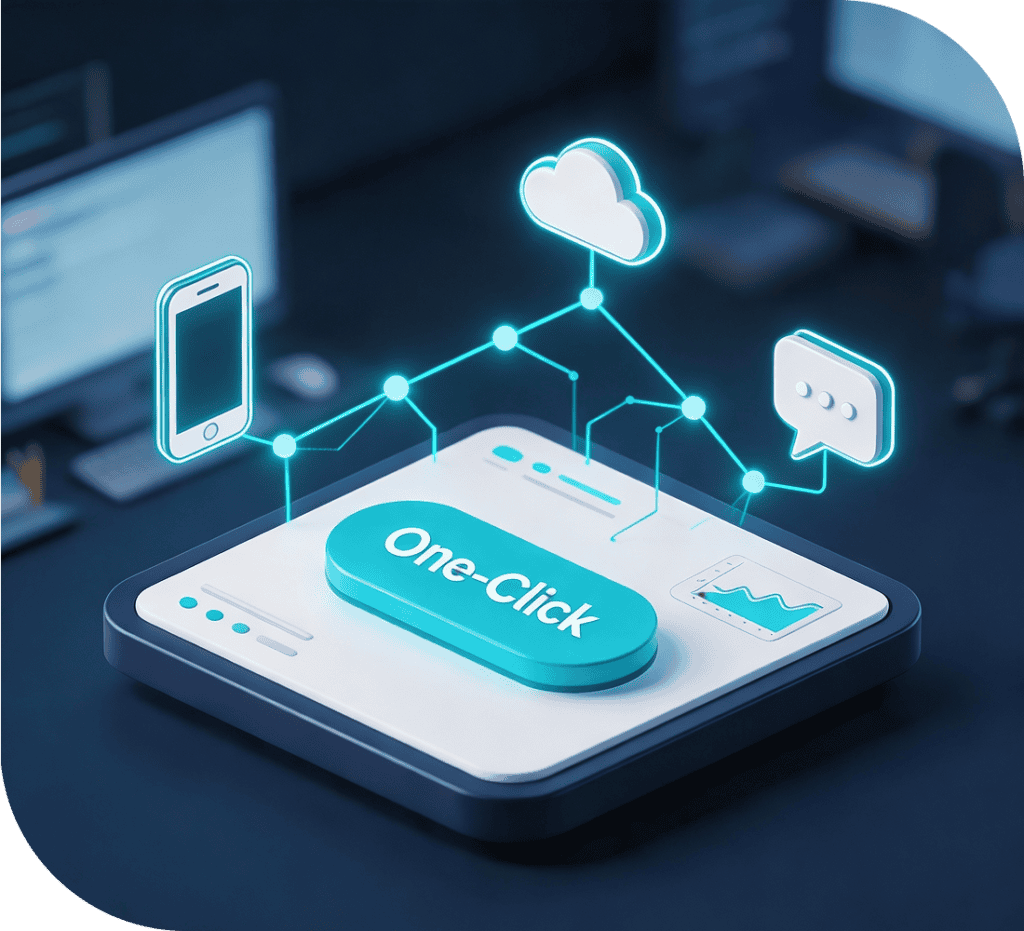
The practical effect: customers sign up for Cloud Voice Manager, pick their numbers, and start making calls. Telnyx is doing the carrier work underneath, but the customer never has to configure it.
Deepgram — Every Conversation Transcribed
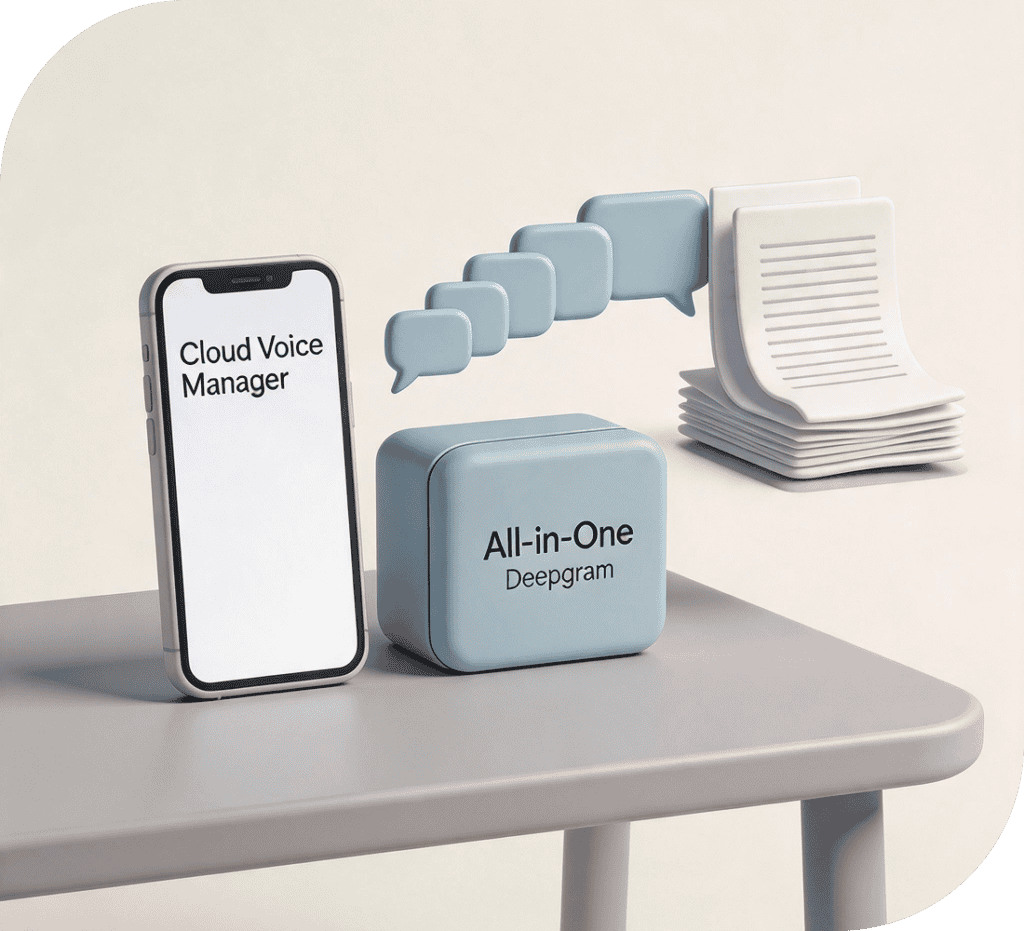
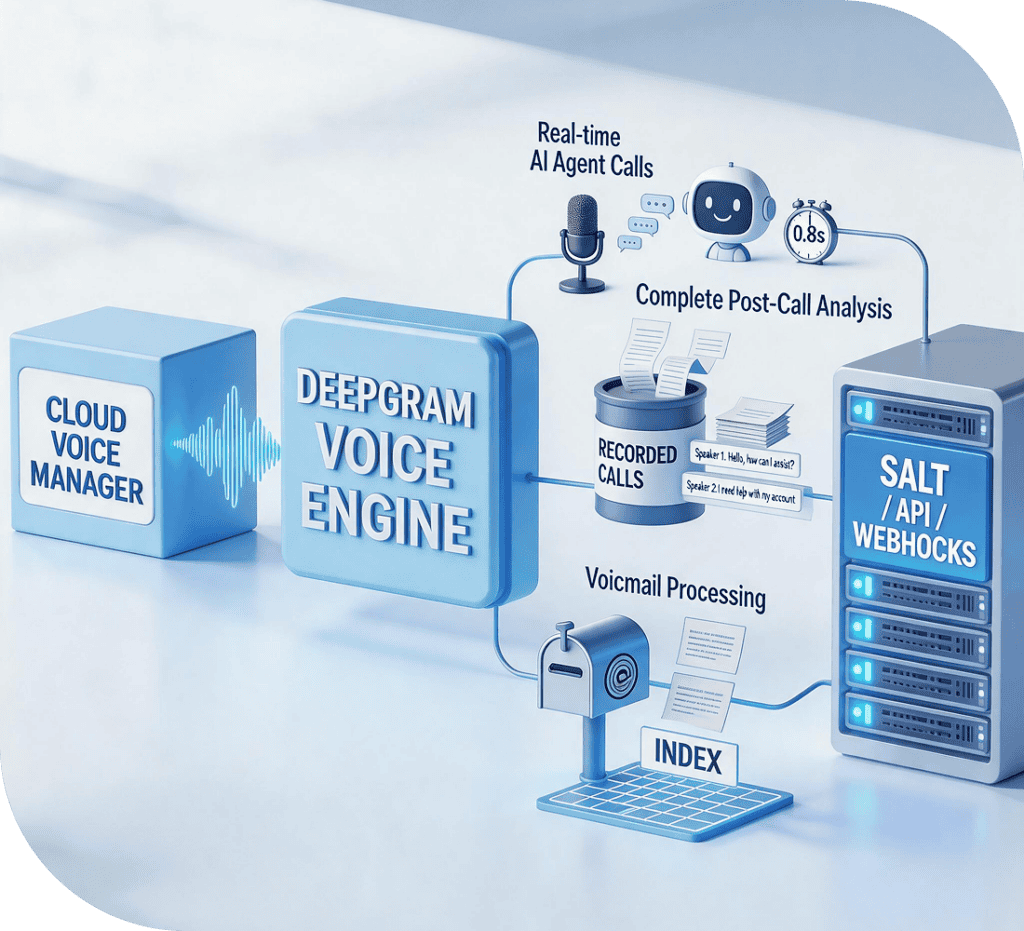
Deepgram powers the speech-to-text layer across Cloud Voice Manager — real-time transcription during AI voice agent conversations, post-call transcript generation for every recording, voicemail-to-text, and the full-text search that makes call history actually useful. The integration is configured at the product level, which means transcription simply runs — no separate Deepgram account, no API key management, no per-minute billing relationship for the customer to track.
What Deepgram Powers Inside Cloud Voice Manager
- Real-time transcription for AI voice agent calls with sub-second streaming latency
- Post-call transcript generation for every recorded call
- Voicemail-to-text on every voicemail left in the system
- Speaker diarization — transcripts separated by speaker so you can follow the flow of the conversation
- Automatic punctuation, capitalization, and paragraph formatting
- Full-text search indexing on every transcript across the entire call history
- Multi-language support for international call flows
- Custom vocabulary injection for industry jargon, product names, and brand terms
- Transcript delivery to SALT CRM, webhooks, and the REST API automatically
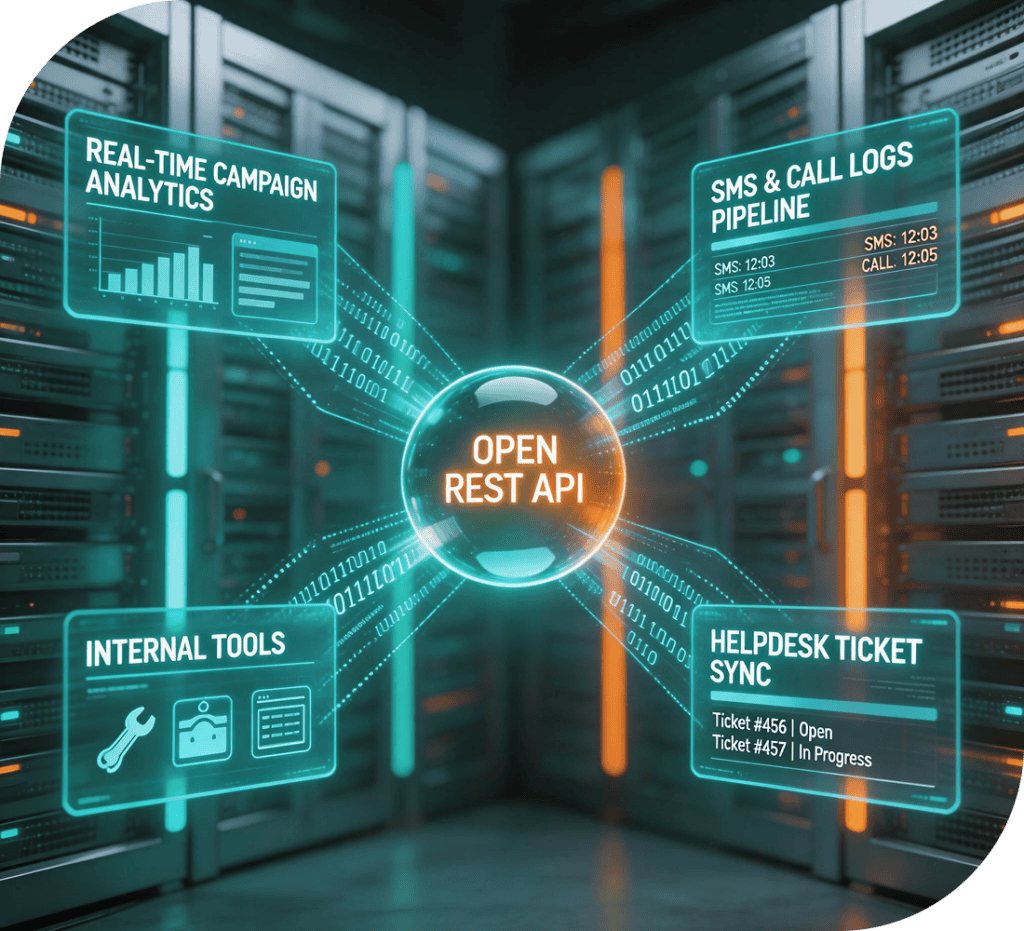
An Open API for What the Native Integrations Don't Cover
API Capabilities
Authentication
API key-based authentication with scoped access tokens. Per-tenant key issuance, revocation, and rotation.
Resource Coverage
Full CRUD on calls, users, extensions, numbers, queues, IVR flows, recordings, transcripts, SMS threads, campaigns, AI agent configurations, and tenants.
Pagination & Filtering
Standard cursor-based pagination. Date range, tenant, user, and status filters across every collection endpoint.
Rate Limiting
Predictable per-key rate limits with clear response headers (limit, remaining, reset). No surprise throttling on production traffic.
Versioning
Stable, versioned API paths. Breaking changes are shipped behind new version prefixes — existing integrations keep working.
OpenAPI Specification
Full OpenAPI / Swagger spec published for client generation and interactive exploration.
Consistent JSON
All responses are JSON. Consistent field naming, consistent error envelope, consistent timestamp format (ISO 8601 UTC).
Test Mode
Sandbox mode for development work without touching production numbers, recordings, or CRM records.
Example: Fetch Recent Calls
GET /api/v1/calls?tenant_id=acme&direction=inbound&limit=50

Authorization: Bearer cvm_live_sk_*** Real-Time Events Delivered to Your Endpoint
The response includes every matched call’s ID, direction, caller, callee, start and end time, duration, outcome, recording URL, transcript URL, AI agent ID (if any), and matched SALT CRM contact ID. Standard pagination on the envelope.
Available Webhook Events
- call.started — a call has been answered or initiated
- call.ended — a call has completed (includes duration, disposition, and recording status)
- call.recording.ready — a call recording has finished processing and is available for download
- call.transcript.ready — the Deepgram transcript for a recorded call is available
- voicemail.created — a new voicemail has been left (includes audio and transcript)
- sms.received — an inbound SMS has arrived on a business number
- sms.sent — an outbound SMS has been delivered or failed
- ai_interaction.completed — an AI voice agent has finished a call (includes transcript, summary, and outcome)
- campaign.call.completed — an outbound dialer call has completed with a disposition
- user.login — an admin or agent has signed in
- tenant.config.changed — a tenant configuration has been updated
Webhook Delivery Guarantees
- HMAC-SHA256 signature on every request so your endpoint can verify the payload is genuine
- Automatic retry with exponential backoff on non-2xx responses
- Delivery log visible in the admin dashboard — inspect every delivery attempt, response code, and payload
- Configurable per tenant, per event type, and per endpoint URL
- Replay — re-deliver a past event to your endpoint manually from the admin dashboard
Works With the Phones You Already Own
Supported Device Classes
- Standards-compliant SIP desk phones from any manufacturer
- SIP-compatible softphone applications on macOS, Windows, Linux, iOS, and Android
- SIP-capable conference room devices and speakerphones
- SIP ATAs (Analog Telephone Adapters) for legacy analog handset support
- WebRTC browser-based calling directly from the Cloud Voice Manager dashboard — no device required
- Headless SIP endpoints for custom integrations (kiosks, call centers, IoT)
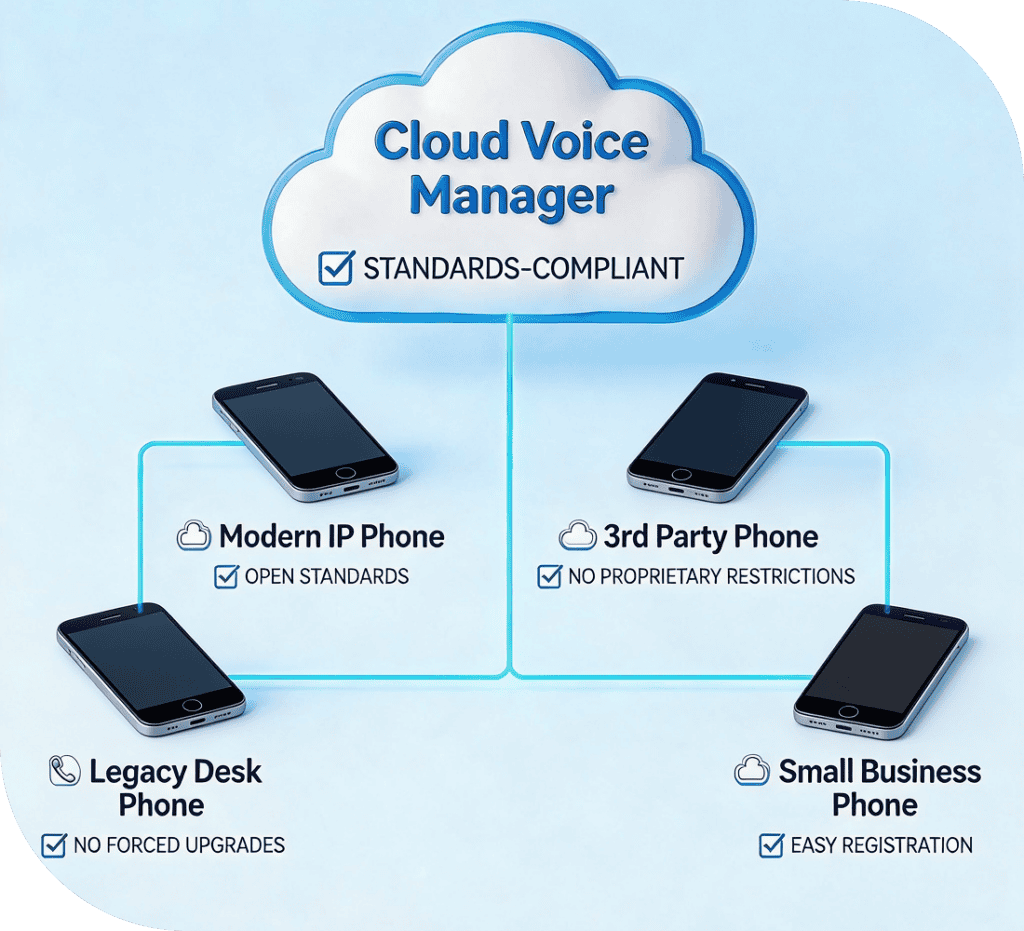
The admin dashboard provides SIP credentials per extension, configuration guidance for common device families, and real-time registration status so you can see which devices are online at any moment.
One Call, Six Integrations, Zero Manual Work
Call Arrives via Telnyx
An inbound call hits the customer's business DID. Telnyx routes the SIP INVITE to Cloud Voice Manager. Call setup is complete in under a second.
Caller Matched in SALT CRM
Cloud Voice Manager checks the caller ID against the SALT CRM contact database. A match is found — the caller is an existing merchant. The contact record is pulled.
HMS Context Loaded
The matched contact triggers a lookup into Host Merchant Services. Account status, recent payment activity, and merchant service details are loaded into the call context.
AI Agent Answers with Full Context
An AI voice agent (configured via Cloud AI Manager) answers the call. The agent greets the caller by name and already knows their merchant status and recent activity.
Deepgram Transcribes in Real Time
The conversation is transcribed live by Deepgram. The AI agent uses the transcript plus the Cloud AI Manager knowledge base to respond accurately. A human transfer happens if needed, with full context.
Everything Logs Automatically
Call ends. A structured activity record, full transcript, AI-generated summary, outcome classification, and recording link are all pushed to SALT CRM. A webhook fires to any connected external system. Nothing is logged manually.
Integrations That Are Actually Maintained
No Middleware Tax
No Zapier subscription, no Make scenario count, no third-party connector licensing. Native integrations ship with the product.
Documented, Not Buried
Every integration — native and API — is documented in a public developer portal. Examples, schemas, and change logs included.
Versioned, Not Brittle
Breaking API changes ship behind new version prefixes. Your existing integrations keep working until you're ready to upgrade.
One Support Team
One vendor, one support relationship for the entire stack. No finger-pointing when something goes wrong in the integration layer.